
The Difficulty in Designing Simplicity
Design Diary #1 for Triptych

Anyone who knows me, knows that I love big games. I especially love games that are so involved that they become events unto themselves, Twilight Imperium being the poster child for such games. Designing such games is difficult because there are so many adjustable levers that you can adjust to create the experience. There are so many asymmetrical factions, so many action cards, so many numbers littered throughout the gameplay that you can adjust to meticulously curate the perfect sandbox for the experience of battling and politicking on the largest scale imaginable. These games often take multiple years to develop because of their sheer scope.
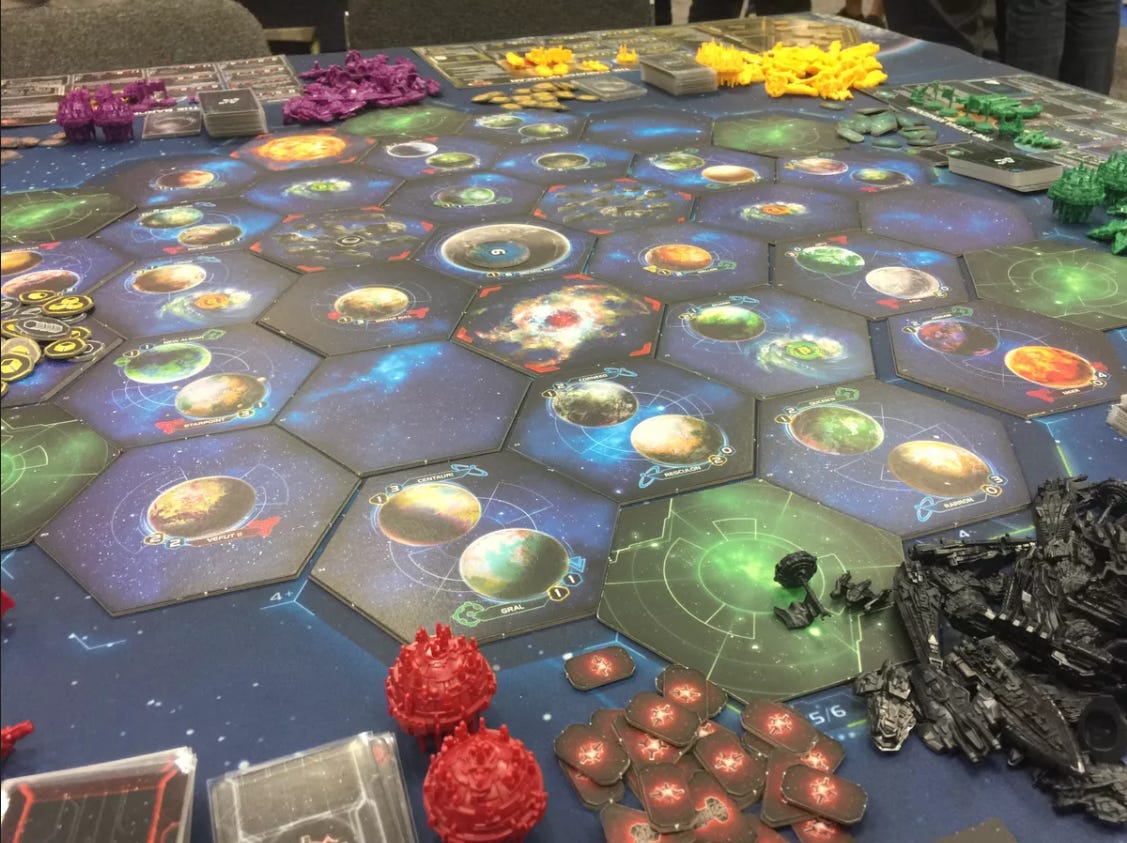
You might assume then, that a simple party game, one that mainly revolves around a singular mechanism, would be very simple to design. This is not the case. I don’t think I’m providing any information that is revolutionary. I think it’s a common expression that simple games are hard to design, but I wanted to dive into why, and then to talk about a game I am working on and the challenges I am running into.
I think there are three main reasons that simple games can be difficult to design. I’m going to take them one at a time, starting with:
1. The Complexity Budget
The complexity budget is how much mechanical depth a game can carry. Think of a game idea as a framework. A simple game’s framework is minimal, and thus can only have so many things attached to it before it collapses under it’s own weight.
If I am designing a 3+ hour long 4X space game, the framework is robust. The game’s concept implies that there will be mechanical subsystems. It’s unlikely that any potential player would expect the military, economic, and political systems of the game to all be handled with a singular streamlined mechanic. Their expectation is much more likely to be that they will have to familiarize themselves with several subsystems that work in concert with each other to create the game.
What this means when designing the game is that I have access to additive mechanical answers to problems. If something isn’t working during development, I can add new systems, steps, phases, pieces, etc. While we should always be considering the trade-offs when we add to a game, part of designing a heavy game is almost always going to be adding to the initial conception. Unless you are a designer who fully conceptualizes a complex ecosystem in their head right from the start that is… but I’m pretty skeptical of anyone who claims that as their process.
When you are making a very simple game, you have very little room for additive modifications to the design. Especially if this is a single mechanic party game. The consumer who is buying a game that sits alongside What Do You Meme? and Cards Against Humanity will assume that game is similarly learnable. I find this often means that I hit roadblocks with these simpler games more often because when I run into problems, the easiest solutions are often additive in nature, and thus are often untenable for these simpler projects.
If the entirety of your game can be described in a single sentence. Adding even another minor mechanic adds a whole other sentence to the rules. In some ways it will then feel like you are doubling the complexity of your game, even if all you’re doing is giving a one-time use token to each player that lets them have 30 extra seconds on a timer.
2. Less Dials To Work With
While the fantasy a simple game evokes will probably be less rich than a more complicated or simulationist style of game, it isn’t any less specific. Given the entirety of experiences that can play out at a table over a game, you are ultimately trying to hit a pretty small target with each game you design. If I’m creating a party game with a silly name, I’m probably not looking to make a player feel tense and panicked or question their own personal beliefs. I’m looking for a fun memorable experience that contained very little stress or struggle of any kind. This is a pretty specific circumstance that you are trying to create with your game.
There is a point in development where we turn from making largescale mechanical changes and are now instead “dialing it in”. What is a dial in this metaphor? Many of them are numerical values: the number of cards in a player’s hand, the amount of a given resource that they collect each turn, how many points meeting a certain objective is worth. Other dials might be single use powers or passive faction abilities; small mechanical pieces that aren’t the structural core of the game and can be changed out without too much of a ripple effect on other parts of the game.
A simple game has less dials, but still needs to evoke that specific circumstance. When you are balancing a complicated game you have so many numbers to raise or lower and so many little powers or action cards that you can alter or exchange. That can be overwhelming, but when I am working on that type of game I almost always feel like the solution is there within those values, and I just need to gently nudge all those pieces bit by bit until they fall into place.
On a simple game there are often so few dials to adjust that it can make you question the whole idea of the game in the first place. It can feel like all the solutions betray the simplicity of the core design because there aren’t obvious ways to alter the gameplay. “If I have to add x to this game for it to work, is this even a worthwhile idea?” is a thought that often creeps into my head. Most of the time the answer is yes, and I just need to go take a walk or get some sleep or find some help to get to the answer, but it’s a discouraging place to be in the process.
3. Off-Limits Mechanics
So we’ve already covered that simple games have less room for adding mechanics, and less mechanics to change when you’re trying to solve development issues. But also, simple games don’t have access to the same mechanical variety as other games.
When you are designing a complex game, you can often include some innovative and challenging mechanics that subvert expectations and take repetition before they become intuitive to the players. There’s always a limit to how much of a game’s mechanical depth can be made from these more challenging mechanics, but as long as they are alongside familiar and understandable mechanics in a complex system, the boundaries for what you can include in your gameplay are very loose.
In a simple game these mechanics have nowhere to hide. If you are adding an innovative mechanic that they’ve never seen before, it has to be very intuitive. Challenging your player’s understanding of what a game can be is not really what lands you a placement in the party game section of Target.
Similarly, even some well understood mechanics that we encounter regularly in hobby games are going to be very difficult, if not impossible, to fit in a simple mass market game. Trick taking is a very familiar mechanic if you grew up playing Euchre or Spades or Hearts, but if you’ve ever tried to explain trick taking to somebody who hasn’t played a game in the genre before, you quickly realize that it’s a pretty complicated mechanic. You have to explain first what a trick is, what it means to establish a suit, what it means to follow. Then if your game has things like trumps, bidding on winning certain tricks, a shoot-the-moon condition… there’s a lot to this style of game. It’s what makes it such a vast genre, but it means you aren’t likely to be able to use it in a mass market party game.
Not only does this restrict your choices during development, it makes it hard to start development on a simple game. How do you make your game seem fresh when you have to rely mainly on mechanics that feel familiar. This is what makes it so hard to design games that will work for a mass market audience. I’ve been thinking about these issues a lot while working on a personal project:
What is Triptych?
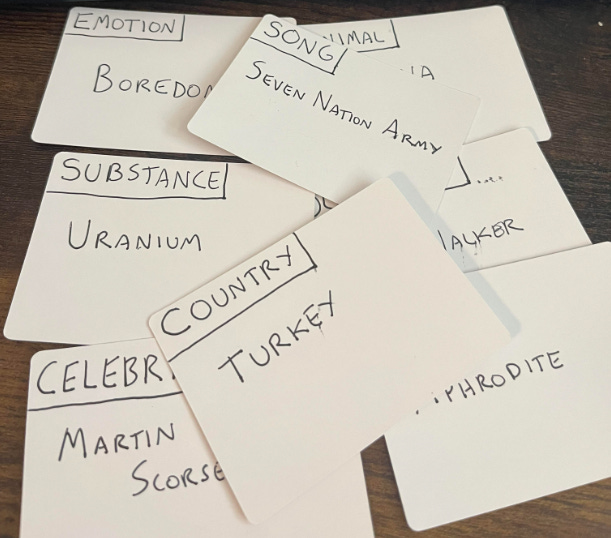
Triptych started from kind of a weird place. I wanted to try to make a party game with a name like “Stop! I’m From The Future!” with a gameplay pattern that echoed time travelers from the future returning to the present to get somebody to stop what they’re doing. I thought the title would really work and that there was a really sellable idea there that I could get a publisher to buy into. My first idea was some kind of 20 questions style game with very specific answers, where the person who was answering the questions could travel back in time and remove specific questions, written on dry erase tiles, from the “timeline” to try and steer them away from directions that wouldn’t help them. It fundamentally did not work.
But it did give me an idea. What if we combined 20 questions with Wordle/Mastermind. This is how Triptych was born. It is a cooperative party game with some thinky elements (I compare it to Codenames) where each round one person draws a card with a word that must be guessed, and a category that word belongs to. Then the other players have a certain number of rounds to try and guess it. Each round the other players write three questions on dry erase tiles and place them in a row on the board. Instead of answering each question with a yes or no specifically like in 20 questions, they only say how many of the answers are yes. The players have to use logic both in how they formulate the questions and in how they make assumptions about what is true.
In our initial playtests (I’m working on this with a partner), the concepts quickly passed the “Is there a game here?” test. There were three big tasks in front of us based on those initial tests:
a. Give the person answering the questions some choices in the gameplay. Right now their position is entirely reactive to what the other players are doing, and that isn’t as fun as we’d like it to be.
b. Dial in the difficulty. Figure out the sweet spot for how hard it should be to guess an average clue and what levels of failure feel fair and permissible.
c. Create a set of card content that reflects the results of tasks a and b.
Right away I had to question the complexity budget of the game in finding something for the question answerer to do that made them feel more active in the game. I wanted to give them some limited use tokens that they could use at their own discretion. What if they could choose one question in play and declare it as a definitive yes or no to help steer the players? What if they had a token that could declare that regardless of whether it was counted as a yes or no, a certain answer is kind of muddy and could be misleading either way you think about it?
These powers add a fair bit of mechanics to a pretty simple game. I had to really consider if this choice was worth it. Ultimately, I decided that because I was shooting more for something like Codenames than What Do You Meme? I could give that player some powers as long as they were easy to understand and there weren’t too many of them. I tried the two token ideas above in a playtest and immediately felt that we were moving in the right direction. These tokens also helped us with b, as they made the game a bit easier and we felt that the initial concept was a bit too difficult on its own.
We have also worked to dial in the difficulty in other ways. Initially the categories were very broad: person, place or thing. This makes every round start very similarly, but it also made it to hard to get to the answer without inflating the number of rounds beyond what we felt was reasonable. We tried more and more specific categories until we found a level of specificity that felt more appropriate.
There are also some epiphanies that people can have while playing the game that allows them to improve at the game, but some players don’t arrive at those epiphanies as easy as others. We also thought the game was more fun once you had those realizations, so we explicitly wove those into the rules to help players be best equipped to enjoy the game.
These changes have been challenging though because the game is so simple, and there’s less room to adjust things than in more complicated games. We’ve managed to push through and find good directions. We’re still adjusting some of those dials and we’re still working on the perfect set of content, but ultimately the game should be ready to pitch at Gen Con this year, but I was glad that my problems could give me something interesting (hopefully…) to write about game design. Hopefully I will have more updates about Triptych as we continue to develop it (and find it a better name).